Best AI Image Generator for Marketing (2026)


The best AI image generator for marketing combines model quality, commercial licensing, and brand consistency in one workflow. getimg.ai leads for marketing teams: 33+ AI models — FLUX.2, GPT Image 1.5, Nano Banana Pro — with an Elements system for brand-consistent outputs, team workspaces, and commercial rights on all paid plans from $8/month. Adobe Firefly adds IP indemnification on qualifying plans for enterprise compliance. Midjourney is widely regarded for high-quality creative output. Leonardo.ai covers model breadth at mid-range pricing. Freepik AI bundles stock assets with AI generation. Krea handles real-time ideation.
TL;DR Best AI Image Generator for Marketing Summary
- getimg.ai gives marketing teams 33+ AI models, an Elements consistency system for brand-consistent images across every campaign asset, image and video generation in one workspace, built-in prompt enhancement, multilingual prompt support, team workspaces, and full commercial rights on all paid plans from $8/month.
- Adobe Firefly offers IP indemnification on qualifying paid plans ($9.99/mo+), deep Creative Cloud integration, and models trained on licensed Adobe Stock content and public-domain material — worth evaluating for brands with compliance requirements, though model updates arrive slower than competitors and premium credits deplete quickly.
- Midjourney's V8 Alpha model (5x faster, native 2K HD) is well-regarded for aesthetic quality in creative campaigns, from $10/month (no free trial on web or Discord) — but text-on-image remains unreliable for text-heavy marketing outputs, and there's no shared team workspace or automated brand consistency system.
- Freepik AI bundles 30+ image models with access to Freepik's stock photo, vector, and template library from ~$7.50/month — useful for designers who need stock alongside AI generation, though the AI tools are secondary to the stock experience.
Best AI Image Generators for Marketing: Ranked
1. getimg.ai — Best AI Image Generator for Marketing Teams
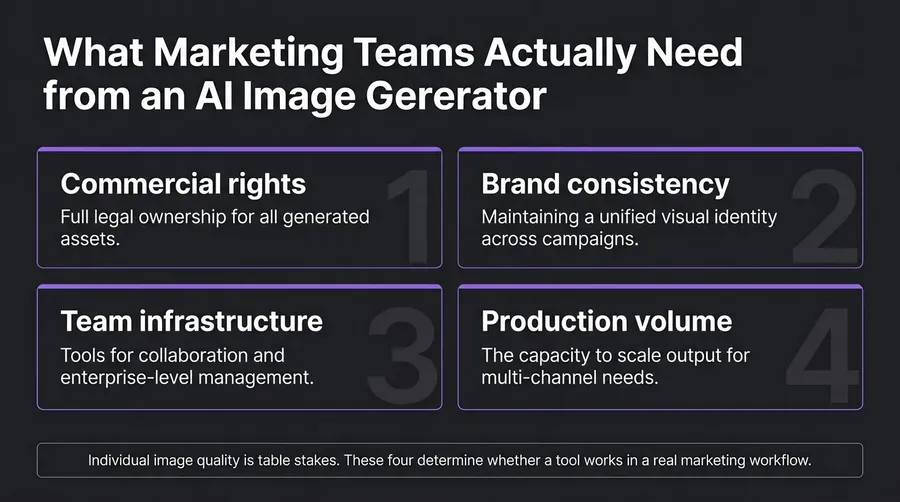
getimg.ai is a professional AI creative platform built for teams producing visual content at scale. For marketing specifically, three capabilities set it apart from every other tool on this list:
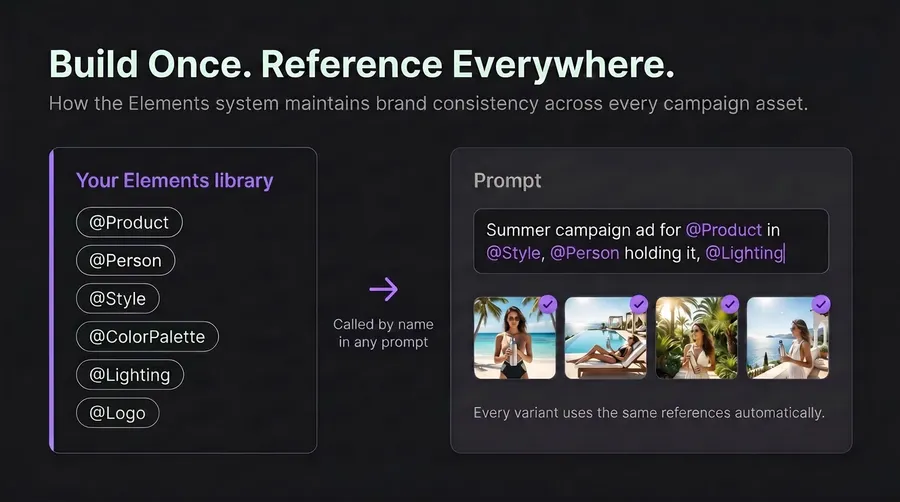
- the Elements system, which stores reusable visual references — product shots, brand characters, style guides, color palettes — so every output stays on-brand across campaigns;
- multi-model access, giving you 33+ AI image models (FLUX.2, GPT Image 1.5, Nano Banana 2, Seedream 5.0 Lite, and more) without managing separate subscriptions; and
- image and video generation in one workspace, so campaigns that need both formats can be produced without switching platforms.
Why it ranks first: Marketing teams need brand-consistent images across dozens to hundreds of assets. getimg.ai is the only platform here with a dedicated consistency system built for production use. Create a Product Element once, then call it into any prompt with @ElementName. Every ad variation, social post, and banner uses the same product reference automatically — this is structural brand consistency, not manual prompt repetition.
The platform handles model selection automatically. Describe what you need; getimg.ai picks the right model for the task. You can also switch manually when a specific model's visual characteristics fit a campaign brief. For a detailed breakdown of which model suits which marketing output, see the guide to image generation models.
What marketing teams use it for:
- Generating AI-generated ads, ad creatives, campaign images, product photography, social content, and banner ads in one workspace — no tool switching between generation and editing steps
- Generating video alongside images in the same workspace — Seedance 2.0 and other video models cover AI-generated video ads, reels, and motion assets, so campaigns that require both formats don't require a separate platform
- Building consistent visual identities using Elements (product references, brand characters, style guides, color palettes, defined lighting, pose references, and Person elements for brand ambassadors or recurring models)
- Localizing visual materials for different regions and languages — prompts are accepted in 20+ languages, so global teams can brief in their native language
- Enhancing prompts automatically before generation — the built-in prompt enhancement feature refines inputs to produce better-matched outputs, reducing iteration time without requiring expert prompting skills
- Running multiple campaign workflows simultaneously — up to 8 or 10 generations at a time on Plus and Ultra plans
- Editing, retouching, background removal, and upscaling (2x) within the same interface
- Team collaboration with shared generations, uploads, Elements, folder organization, and up to 10 team workspaces on Ultra
Feature | Detail |
Image models | 33+ (FLUX.2, GPT Image 1.5, Nano Banana 2, Seedream 5.0 Lite, Grok Imagine, and more) |
Video generation | Seedance 2.0 and other video models — image and video in one workspace |
Brand consistency | Elements: Product, Person, Style, Color Palette, Lighting, Pose, Character, and more |
Prompt enhancement | Built-in; auto-refines prompts before generation |
Multilingual prompts | Accepts prompts in 20+ languages |
Editing tools | Inpainting, background removal/swap, upscaling (2x), style transfer, outpainting |
Team workspaces | Core (2 teams), Plus (5 teams), Ultra (10 teams) |
Parallel generations | Entry: 2 / Core: 4 / Plus: 8 / Ultra: 10 |
Commercial rights | Included on all paid plans |
Starting price | $8/month (Entry: 3,000 credits, 11 image models) |
All models from | $25/month (Core: 15,000 credits) |
Best for: Marketing teams, social media managers, and creative directors who need brand-consistent, commercial-ready images and video at scale — including global teams generating localized campaign materials across multiple markets.
2. Adobe Firefly — IP Indemnification and Creative Cloud Integration
Adobe Firefly targets brands in regulated industries or with legal teams that require documented IP safety. Its models are trained on licensed Adobe Stock content and public-domain material where copyright has expired — Adobe does not mine the web for training data. Qualifying paid plans from $9.99/month include IP indemnification: Adobe may cover legal costs for eligible Firefly-generated output, subject to plan terms and usage conditions.
Why it ranks here: The indemnification guarantee is uncommon in this market. For enterprise marketing departments, agencies managing high-profile brand accounts, and compliance-sensitive industries like financial services or healthcare, this is the primary reason to consider Firefly. Its Creative Cloud integration — Generative Fill in Photoshop, Generative Expand, text-to-image in Adobe Express — means teams already inside the Adobe ecosystem can add AI generation without restructuring their workflow.
Tradeoffs: Firefly's own image model is generally considered less competitive than FLUX.2 and GPT Image 1.5 for creative marketing output. New model integrations arrive months after competitors. Premium features (video generation, partner model outputs from Google and OpenAI) consume credits quickly — costs escalate faster than the headline price suggests.
Feature | Detail |
Image models | Firefly Image 5 (own model) + partner models (Google, OpenAI, Luma AI, Runway, Topaz, and more) |
Brand consistency | Via Creative Cloud Libraries; no dedicated Elements system |
Commercial rights | IP indemnification on qualifying paid plans ($9.99/mo+) |
CC integration | Photoshop, Illustrator, Premiere Pro, After Effects, Express |
Starting price | $9.99/month (Standard: 2,000 premium credits, unlimited standard generations) |
Who uses it: Enterprise marketing teams with legal or compliance requirements, and those deeply integrated into the Adobe Creative Cloud workflow.
3. Midjourney — Art-Focused, Limited Workflow Features
Midjourney's V8 Alpha model (released in March 2026) generates native 2K HD images at 5x the speed of previous versions, with stronger prompt comprehension and incremental improvements to text rendering. For brand campaigns, editorial creative, and high-visibility marketing assets where aesthetic quality carries significant weight, the image output tends to hold up across styles.
Why it ranks here: Midjourney is well-regarded for aesthetic quality — particularly for lifestyle photography, editorial illustration, and visual direction work. For marketers art-directing campaigns or producing creative assets where overall image feel matters, it might perform well. That said, for marketers who need an AI image generator with reliable text on images — ads, banners, feature callouts, pricing cards — Midjourney is not the right choice. Even with V8's improvements, it struggles with text-heavy layouts and multi-element copy. Models like Nano Banana 2 are considerably more reliable for those use cases.
Tradeoffs: No shared team workspace — Midjourney has no purpose-built shared team workspace or structured multi-user environment for campaign production. Personal organization (Folders, Folder Groups, Saved Searches) is available for individual accounts, but these don't extend to shared team use.
No automated brand consistency system — maintaining visual coherence across assets requires manual prompt discipline. Stealth mode (private images — essential for unreleased campaign work) requires a $60/month plan minimum. The image editor handles selection, retexturing, and inpainting but doesn't match a full editing workflow.
Feature | Detail |
Image models | Midjourney V8 Alpha (2K HD, 5x faster; text-on-image still unreliable for heavy copy) |
Brand consistency | No dedicated system; requires manual prompt consistency |
Image editor | Smart Select, Erasing, Retexture, Vary Region, Remix, custom aspect ratios |
Personal organization | Folders, Folder Groups, Saved Searches (individual accounts only) |
Team workspaces | No shared team workspace |
Private images | Requires $60/month (Pro plan) minimum |
Commercial rights | All paid plans; >$1M annual revenue companies require $60/mo+ |
Starting price | $10/month (Basic: 3.3 GPU hours Fast Mode, no Relax mode) |
Who uses it: Art directors and creative leads focused on output aesthetics for campaign concepting, visual direction, or premium brand assets — and who don't need team workspaces or a brand consistency system.
4. Leonardo.ai — Multi-Model Access at Mid-Range Pricing
Among the tools on this list, Leonardo.ai most closely matches getimg.ai in terms of model range. It integrates GPT Image 1, FLUX.1 Kontext, Veo 3, Kling 2.6, and Nano Banana alongside its own Phoenix 1.0 and Kino XL models. The AI Canvas provides editing tools, and LoRA training lets users create custom style models — useful for brand-specific visual styles.
Why it ranks here: The $12/month Essential plan includes 8,500 fast tokens and full commercial rights — accessible for individual marketers and small creative teams. Team plans are available for multi-user environments with shared tokens and private generations. The community asset marketplace surfaces models and styles built by other creators, a practical resource for marketers exploring specific visual directions without training their own.
Tradeoffs: The token pricing system is confusing. First-party and third-party models cost different amounts, and third-party models — FLUX.1 Kontext, GPT Image — always consume tokens at full speed with no relax fallback. Free plan images are public and reusable by Leonardo, creating privacy exposure for unreleased campaign work.
Feature | Detail |
Image models | Phoenix 1.0, Kino XL + third-party: GPT Image 1, FLUX.1 Kontext, Nano Banana |
Brand consistency | Character reference; no Elements-equivalent |
Editing tools | AI Canvas, inpainting, LoRA training |
Team workspace | Team plans available (shared tokens, private generations) |
Commercial rights | Paid plans only; free plan images are public and reusable by Leonardo |
Starting price | $12/month (Essential: 8,500 fast tokens, annual billing) |
Who uses it: Individual marketers and creative freelancers who want broad model access at a mid-range price, and small teams who can work with Leonardo's team plan structure but don't need a dedicated brand consistency system.
5. Freepik AI — Stock Library Bundled with AI Generation
Freepik AI is a practical option for designers and marketers who work within the Freepik ecosystem or who regularly need stock photos, vectors, and templates alongside AI generation. A single subscription covers both — the Essential plan (~$7.50/month annual) includes 30+ image models and access to Freepik's full stock library under a commercial license.
Why it ranks here: For workflows that combine AI-generated custom assets with licensed stock imagery — backgrounds, textures, templates — Freepik covers both under one billing line, which reduces tool sprawl. The model library includes FLUX.2 Max, FLUX.2 Flex, Google Imagen 4, Nano Banana Pro, and FLUX.1 Kontext, so the generation capability is production-quality, not incidental.
Tradeoffs: AI generation is secondary to the stock library product. There's no Elements-equivalent for brand consistency and no team workspace purpose-built for AI production. An Auto option in the Image Generator can select a model for you, but the AI tools feel integrated into a stock platform rather than built from the ground up for creative production.
Feature | Detail |
Image models | 30+ including FLUX.2 Max/Flex, Google Imagen 4, Nano Banana Pro, FLUX.1 Kontext |
Stock library | Photos, vectors, templates, illustrations — all included |
Brand consistency | No dedicated system |
Team workspace | No purpose-built AI team workspace |
Commercial rights | Essential tier and above |
Starting price | ~$7.50/month (annual billing) |
Who uses it: Marketing designers who need licensed stock assets and AI generation in one subscription, particularly those already inside the Freepik ecosystem.
6. Krea — Real-Time Generation for Concept Exploration
Krea generates images in near real-time, making it one of the fastest options on this list for rapid visual experimentation. The real-time canvas lets creative teams test visual directions, iterate on brand concepts, and explore style variations before committing to production — a fundamentally different workflow from the tools above.
Why it ranks here: For the ideation phase of a marketing workflow — exploring visual directions, generating reference imagery for briefs, testing brand aesthetics — Krea's near real-time speed is a practical advantage. Its 22K image upscaling capability is notable. The Pro plan adds Nodes, an automation feature for building generation workflows, and LoRA training for custom visual styles.
Tradeoffs: Krea is better suited to ideation than production at scale. Consistency across many assets tends to be a limitation. No dedicated brand consistency system. No editing workflow comparable to getimg.ai's full post-generation toolkit. Commercial terms are clear on paid plans.
Feature | Detail |
Image models | 20+ including FLUX, Krea 1 (proprietary), Luma, Ideogram |
Brand consistency | LoRA training; no Elements-equivalent |
Real-time generation | Near real-time |
Upscaling | Up to 22K resolution |
Automation | Nodes (Pro+) |
Team / enterprise | Centralized billing and collaboration available on enterprise plans |
Commercial rights | Basic plan and above; no commercial rights on free tier |
Starting price | Free tier available; paid plans with full feature access |
Who uses it: Creative directors and art directors in the concept and ideation phase of a campaign who iterate visually before briefing a production team.
AI Image Generator Comparison Table
Tool | Starting price | Image models | Brand consistency | Team workspace | Commercial rights |
getimg.ai | $8/month | 33+ image + video (auto-selected) | Elements system (Product, Person, Style, Color Palette, Character) | Core+ (up to 10 teams on Ultra) | All paid plans |
Adobe Firefly | $9.99/month | Firefly Image 5 + partner models | Via CC Libraries | Via Creative Cloud collaboration tools | IP indemnification on qualifying paid plans |
Midjourney | $10/month | V8 Alpha (2K HD, 5x faster) | Manual only | No shared team workspace | All paid plans; >$1M revenue needs $60/mo |
Leonardo.ai | $12/month | Phoenix 1.0 + third-party (GPT Image, FLUX.1 Kontext, etc.) | Character reference | Team plans available | Paid plans only (free outputs public) |
Freepik AI | ~$7.50/month | 30+ models | No dedicated system | No | Essential tier and above |
Krea | Free / paid | 20+ models | LoRA training | Enterprise plans | Basic plan and above |
How to Choose the Right AI Image Generator for Marketing
1. Prioritize commercial rights clarity before model quality.
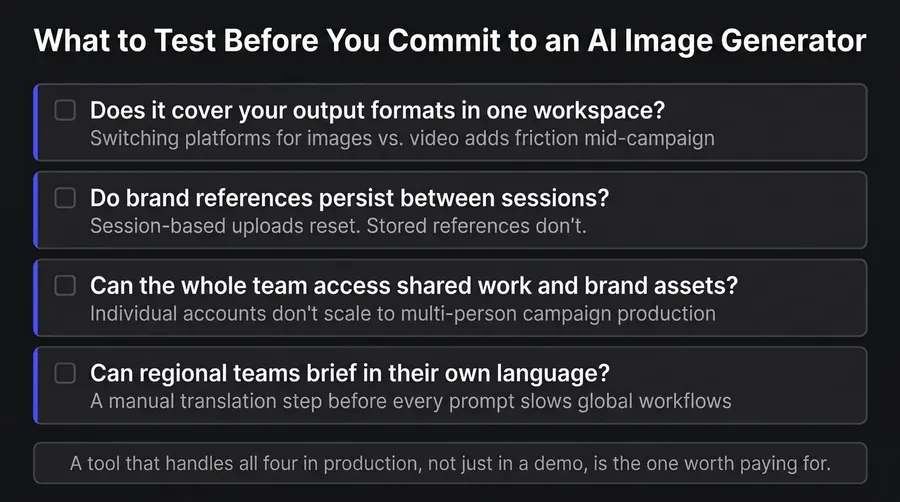
Every tool on this list produces strong images. The question that matters for marketing is whether you can use those AI-generated ads and creatives in paid campaigns, client work, and commercial materials — without restrictions or additional licensing costs. getimg.ai and Midjourney include commercial rights on all paid plans. Adobe Firefly adds IP indemnification for brands that need it. Confirm what's included at your specific plan level before generating assets for paid media.
2. Evaluate brand consistency tools if you run multiple campaigns.
One-off image generation works for individual assets. At scale — multiple ad variants, recurring social content, seasonal campaign updates — manual prompt consistency breaks down. Look for structural consistency features: getimg.ai's Elements (Product, Style, Color Palette, Lighting references stored in your account), not just reference image uploads that reset with each session. Brand consistent AI images require a system, not just good prompts.
3. Match team structure to platform capabilities.
Solo marketers can work on any platform. Teams producing creative AI for marketing need shared workspaces, folder organization for campaigns, and shared brand references accessible to all members. getimg.ai's team spaces — available from Core at $25/month — and shared Elements are designed for multi-person creative production. Few competitors offer equivalent purpose-built team infrastructure for AI production.
4. Consider where AI generation fits your existing stack.
If you're deeply integrated into Adobe Creative Cloud, Firefly's Photoshop and Express integrations reduce workflow friction. If you generate standalone assets without CC dependency, a dedicated platform like getimg.ai is more efficient. If you regularly need stock images alongside AI output, Freepik AI bundles both. The best AI image generator for marketers is the one that fits the workflow they already use.
5. Factor in multilingual and localization requirements for global campaigns.
If your marketing team spans multiple regions, the ability to prompt in 20+ languages — and generate imagery that reflects regional cultural contexts — reduces a translation bottleneck. getimg.ai accepts prompts in 20+ languages, so local market teams can brief in their native language rather than through a translation layer. Combined with Person elements (store a brand ambassador or recurring model reference once, apply across regional campaigns), this creates a practical workflow for brands producing localized visual materials across markets.
6. Test with your actual production volume, not a demo prompt.
Real-time ideation, production-quality campaign assets, and brand-consistent product photography are different workloads with different cost profiles at scale. A tool that performs well for 10 images per month may be impractical at 500. Check credit costs on the models you'll actually use most, not the headline plan pricing.
The Bottom Line
For marketing teams, the decision comes down to one question: do you need brand-consistent images at scale, or one-off quality outputs?
getimg.ai is built for the former. The Elements system means your product, Person (model, brand ambassador), and style references carry across every campaign — no re-attaching reference images, no drift. With 33+ models auto-selected per task, image and video generation in one workspace, built-in prompt enhancement, multilingual prompt support for global teams, team workspaces from the Core plan, and full commercial rights from $8/month, it's the only platform on this list where generation, editing, brand consistency, and localization share a single workflow.
The alternatives each cover a narrower slice: Adobe Firefly for compliance-first enterprise environments, Midjourney for aesthetic-driven creative work without team infrastructure, Freepik AI for stock-plus-generation bundles, and Krea for pre-production concept exploration.
If your team ships visual content daily — campaign assets, social content, product imagery — start creating with getimg.ai, commercial rights included.
Frequently Asked Questions
The best AI image generator for marketing teams is getimg.ai. It combines 33+ AI image models — including FLUX.2, GPT Image 1.5, and Nano Banana 2 — with an Elements system for brand-consistent outputs, team workspaces, full editing tools, and commercial rights on all paid plans from $8/month. Adobe Firefly includes IP indemnification on qualifying plans from $9.99/month, worth evaluating for brands with documented compliance requirements. Midjourney (from $10/month) generates high-quality images but lacks shared team workspaces and brand consistency tools. The right choice depends on team size, brand consistency requirements, and compliance needs.
Yes, provided your plan includes commercial rights. getimg.ai includes commercial rights on all paid plans from $8/month. Adobe Firefly includes IP indemnification on qualifying paid plans ($9.99/month+) — Adobe may cover legal costs for eligible Firefly-generated output, subject to plan terms and usage conditions. Midjourney grants commercial rights to all paid subscribers — companies with over $1M annual revenue require a $60/month plan. Leonardo.ai grants rights on paid plans only; free plan outputs are public and reusable by the platform. Always verify specific terms at your plan level before using generated content in paid media.
The most reliable method is a dedicated consistency system, not prompt repetition. getimg.ai's Elements feature lets you create reusable references for products, brand characters, visual styles, color palettes, and lighting setups — stored once in your account, called into any prompt with @ElementName.
Every output that follows uses the same reference automatically. This eliminates the drift that comes from recreating prompts manually across campaigns. The Person element is particularly useful for brands that rely on a consistent model or brand ambassador: store the person reference once and generate that individual appearing in any scene, environment, or context across campaign materials. See the guide to Elements for setup instructions.
Marketing-specific requirements differ from general creative use in three ways: commercial licensing (assets must be usable in campaigns, paid ads, and client work without restrictions), brand consistency (outputs must match established visual identities across many assets in a campaign), and production volume (marketing teams produce dozens to hundreds of assets per campaign cycle, not individual images).
General-purpose generators optimize for visual quality per image. Marketing tools need to deliver structural consistency and workflow efficiency across the full campaign lifecycle — which is why features like getimg.ai's Elements system and team workspaces matter beyond individual image quality.
Yes — AI-generated ads are one of the primary use cases for tools like getimg.ai. Static display ads, social ad creatives, banner ads, and AI-generated video ads can all be produced within the platform. The Elements system keeps your product, brand character, or style reference consistent across every ad variant in a campaign, so running multiple ad sets across channels doesn't require re-prompting from scratch.
Parallel generation (up to 10 simultaneous outputs on Ultra) speeds up ad creative production for teams working at volume. All AI ad creatives generated on paid plans include commercial rights, so outputs are cleared for use in paid media immediately.
Yes — getimg.ai includes video generation models (including Seedance 2.0) in the same workspace as image models. This means campaigns that require both still and motion assets — a product launch with social images, a hero video, and banner variants — can be produced in one platform without switching tools.
For video-heavy campaigns (social reels, ads, product demos), access to dedicated video models alongside the full image generation workflow eliminates the context switching that comes from using separate platforms for each asset type.
Yes. getimg.ai accepts prompts in 20+ languages, which makes it practical for global marketing teams operating across multiple regions. Local market teams can brief in their native language rather than translating prompts into English first.
For marketing outputs where text accuracy matters — ads, banners, feature callouts, pricing graphics, promotional cards — model choice makes a significant difference. Nano Banana 2, available in getimg.ai, handles dense on-image text reliably, including multi-word headlines, pricing callouts, and CTA copy. GPT Image 1.5 also performs well for text-heavy compositions.
Related Articles