Can AI-Generated Images & Videos Be Used Commercially?
The short answer is: AI-generated content often can be used commercially, but the specifics depend on three things: which platform you used to generate the content, what jurisdiction you operate in, and whether the output has been substantially shaped by human creative decisions.
Many professional AI image and video platforms explicitly grant commercial rights to paid subscribers. The harder question isn't whether you're allowed to use AI-generated content commercially. It's whether you own a copyright in what you create (and what that means in practice when clients, competitors, or legal teams get involved).
This guide covers the current legal landscape, platform-by-platform policies, the actual risks creative professionals face, and how to structure your workflow to reduce exposure.
TL;DR Commercial Use of AI Images & Videos
- AI-generated images and videos can be used commercially, but you need platform permission (a commercial license) and, separately, meaningful human creative input if you want copyright ownership in the output.
- most major AI platforms grant commercial rights (e.g., getimg.ai) to paid subscribers; free plans typically do not. Revenue thresholds apply at some platforms for larger organizations.
- under US law (2025 USCO guidance) and EU law (CJEU case law), substantial human editing is what builds a defensible copyright claim.
- jurisdiction matters: the UK is more permissive under CDPA s.9(3); China's courts have taken a broader view of prompt-based authorship.
What "Commercial Use" of AI Content Actually Means
Commercial use means deploying AI-generated content to generate revenue, promote a business, or support paid client work. This includes advertising campaigns, e-commerce product photography, social media content for brands, book covers, merchandise, website imagery, and client deliverables.
Two separate questions govern whether you can do this legally:
1. Does the platform's terms of service permit commercial use? That's a contract question between you and the AI tool provider.
2. Do you hold a copyright in the output? That's a question of intellectual property law, and the answer is frequently not immediately clear.
Many creative professionals conflate these. A platform can grant you a license to use generated content commercially while you simultaneously hold no enforceable copyright in the image itself. Understanding both layers matters for professional use.
Commercial License vs. Copyright: Two Different Things
These are distinct legal concepts that operate independently of each other.
A commercial license is permission, granted by your AI platform through its terms of service, to use generated outputs for commercial purposes. It's a contractual right. When a platform says "commercial rights included," it means: you're permitted to publish, sell, and deploy this content in paid work. You're not violating the platform's terms by using the output in an ad campaign or client deliverable.
Copyright is a separate legal protection — an exclusive right that attaches to a creative work and lets the rights holder control reproduction, distribution, and adaptation. Copyright lets you stop others from copying your work. It's the basis for licensing deals, client IP transfers, and infringement claims.
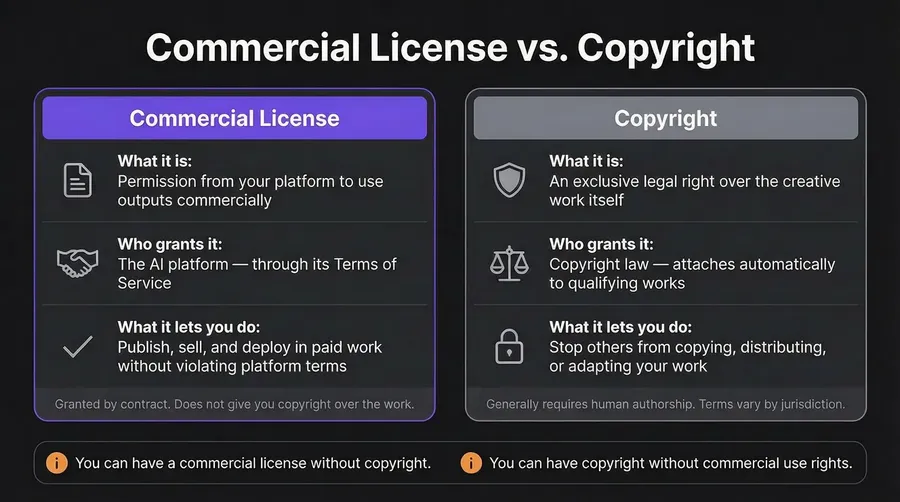
The critical point: you can have one without the other.
- A platform can grant you a commercial license while the output has no copyright attached (because no human authored it in the legally meaningful sense). You're free to use the image commercially, but so is anyone else who gets hold of it. You have no exclusive claim.
- Conversely, a highly modified AI-assisted work might qualify for copyright protection, but if your platform's terms restrict commercial use, you still can't deploy it in paid work without violating the contract.
For most professional use cases — advertising, client work, product imagery, AI social media content — the commercial license question is straightforward: check your plan. The copyright question requires more thought, especially when clients expect to receive transferable IP or when the work has significant standalone commercial value.
Does Your AI Platform Allow Commercial Use?
Licensing terms vary significantly, including revenue thresholds that affect enterprise users. Most (although not all) platforms that offer a free tier either prohibit commercial use entirely. Watermarks are common on free-tier outputs for the same reason: they signal that the output isn't licensed for professional deployment.
The practical rule of thumb: if you're on a free plan, assume commercial use isn't covered unless the platform explicitly states otherwise, and verify before you publish. You can usually find licensing terms in terms of service or similar legal documentation.
What "commercial rights included" means on getimg.ai? Every paid plan — from Entry at $8/month to Ultra at $150/month — includes full commercial licensing. You can publish, sell, and use generated content in client work, merchandise, advertising, and social media without an additional license fee. There is no enterprise tier gating commercial rights; they're included from day one. The same applies across shared team spaces— all members generate under the same commercial terms.
What the Law Says: Can You Actually Hold Copyright to an AI-Generated Image?
Platform permission and legal ownership are separate. Once you've confirmed your platform's terms allow commercial use, the copyright question remains — and the answer, under current law in most jurisdictions, is: not automatically.
US Law: The Human Authorship Requirement
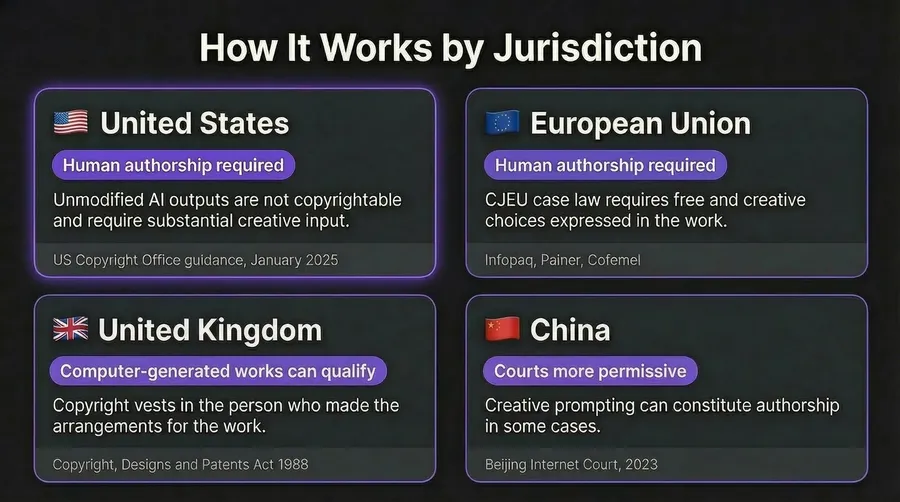
In January 2025, the US Copyright Office released definitive guidance: works produced entirely by AI, without meaningful human creative input, are not copyrightable. Human authorship is "the bedrock of copyrightability."
Specifically:
- Not protected: prompts alone do not constitute authorship. Unmodified AI outputs cannot be copyrighted, regardless of how detailed or creative the prompt was.
- Protected: human-authored elements expressed in AI-assisted work — creative selection, arrangement, and modification of AI outputs — can qualify for copyright protection.
- Partially protected: a work combining AI-generated material with substantial human creative contribution receives copyright protection scoped to the human-authored portions.
This position was reinforced in March 2026 when the US Supreme Court declined to hear Thaler v. Perlmutter, allowing lower court rulings to stand: AI systems cannot hold copyright, and neither can the developer of the AI system by virtue of having built it.
The Zarya of the Dawn case (February 2023) drew the line in practice. Artist Kristina Kashtanova used Midjourney to generate all illustrations in a comic book, then arranged them with human-written text. The Copyright Office cancelled and re-issued her registration with narrow scope:
- Protected: the text, and her selection and arrangement of visual and written elements.
- Not protected: the Midjourney-generated images themselves — the "trial-and-error" prompting process didn't give her sufficient control over specific visual expression.
EU Law: The CJEU "Free and Creative Choices" Standard
The EU has no specific legislation on AI output copyrightability. What governs the question is a body of Court of Justice (CJEU) case law establishing the conditions under which any work qualifies for copyright protection.
The CJEU established a harmonized EU originality standard in Infopaq International v. Danske Dagblades Forening (C-5/08, 2009): a work is protected only if it is an "author's own intellectual creation." Subsequent rulings developed this into a concrete test:
- Painer v. Standard Verlags (C-145/10, 2011): a portrait photograph is protected where the author made free choices — framing, angle, lighting, atmosphere — that express their personality. The creative protection lies in the specific choices made, not in the act of pressing a shutter.
- Football Dataco v. Yahoo! (C-604/10, 2012): intellectual effort and skill alone do not create copyright. There must be free and creative choices that express originality. Labor without authorial expression in the output is not enough.
- Cofemel v. G-Star Raw (C-683/17, 2019): the same standard applies across all categories of work — a work must reflect the author's own intellectual creation through free and creative choices.
Applied to AI-generated content: if the AI model determines the visual expression — composition, color, form, texture, lighting — in response to a prompt, the machine is making the choices expressed in the output. The human provided an instruction; the work reflects the AI's decisions. Under this framework, that does not meet the originality standard.
The EU AI Act (in force August 1, 2024) adds transparency obligations for AI providers but does not change the copyrightability test. Outputs are still evaluated against the CJEU standard above.
Outside the US and EU: Check Your Jurisdiction
Copyright law for AI-generated content is not globally harmonized, and the differences are significant enough to matter in practice.
United Kingdom
For example, the UK Copyright, Designs and Patents Act 1988 contains a provision — section 9(3) — specifically addressing computer-generated works. It grants copyright to "the person by whom the arrangements necessary for the creation of the work are undertaken," with a 50-year term. This is more permissive than both the US and EU positions: purely computer-generated works can be copyrighted in the UK without a human author, and the copyright vests in whoever set up and ran the generation.
Post-Brexit, this provision remains in force and has not been amended to address generative AI specifically, though whether modern AI prompting constitutes "making the arrangements" remains an open question for UK courts.
China
In China, courts have taken a notably different approach. In a 2023 Beijing Internet Court ruling (Li Yunkai v. Liu Yuanchun), the court held that an AI-generated image qualified for copyright protection where the human made creative choices through prompting — framing the selection of prompts, parameters, and iterations as expressive authorial acts. This stands in contrast to the US position that prompting alone is insufficient. China does not have a unified legislative position yet; the 2023 ruling is influential but not binding across all courts.
If you're operating outside these jurisdictions (or distributing content internationally) verify the applicable local law before making assumptions about copyright ownership. The spread between the UK's more permissive position and the US/EU's stricter requirement is wide enough that jurisdiction can materially change your rights.
Why Copyright Ownership Matters for Commercial Work
The commercial license question is relatively easy to resolve — as mentioned, just check your plan and licensing terms. The copyright question takes more thought, but it's worth understanding before you put significant commercial value behind AI-generated assets.
What does lack of copyright mean?
- You cannot prevent copying. With no copyright in an unmodified AI output, a competitor who sees your campaign asset can legally reproduce it. You have no infringement claim.
- You may not be able to transfer IP to clients. Clients commissioning creative work often expect to receive transferable copyright, meaning the right to control and license the asset independently. If the work is unmodified AI output, there's no copyright to transfer. This is worth addressing explicitly in client agreements before the work begins.
- Derivative work licensing gets complicated. Downstream resale, adaptation, or sub-licensing of AI-generated assets — common in stock, publishing, and brand work — relies on copyright ownership that may not exist.
The fix is straightforward but requires intention. Human creative decisions at the level of the output are what establish copyrightability.
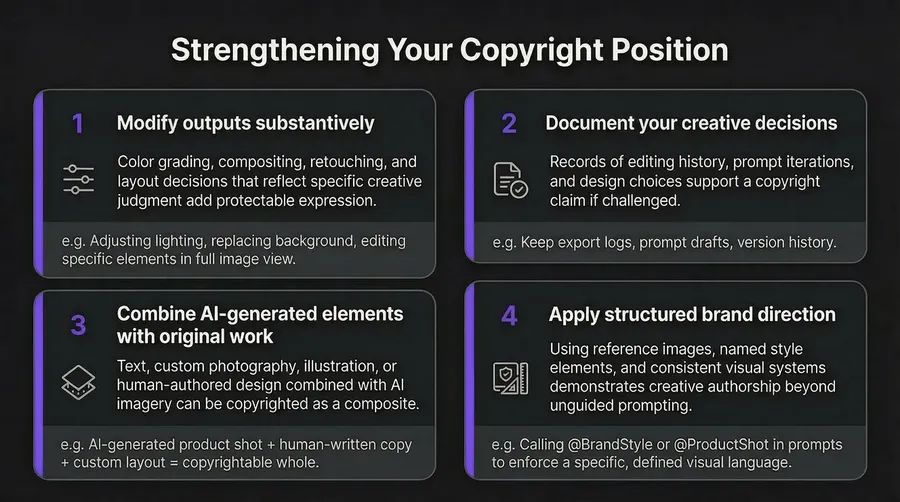
Practically:
- Modify outputs substantively (color grading, compositing, retouching, and layout decisions that reflect specific creative judgment add protectable expression).
- Document your creative decisions (records of editing history, prompt iterations, and design choices support a copyright claim).
- Combine AI-generated elements with original work (text, custom photography, illustration, or human-authored design combined with AI imagery can be copyrighted as a composite).
- Apply structured brand direction (using reference images, style Elements, and consistent visual systems demonstrates creative authorship that goes beyond unguided prompting).
The closer your contribution is to the expressive decisions visible in the final work, the stronger your copyright position. Prompting alone might not get you there (depending on the jurisdiction and other generation settings), but prompting followed by meaningful editing typically does.
How to Use AI-Generated Content Commercially Without Legal Headaches
Before generating:
- Confirm your plan includes commercial rights and verify any revenue thresholds apply to your organization.
- Know what your platform restricts (e.g., real people, living artist styles, trademarks, certain types of content).
During production (if your jurisdiction has a high threshold for copyright protection):
- Apply specific brand and style direction (reference images, style Elements, and structured prompts may demonstrate human creative authorship).
- Document prompt iterations and creative decisions
- Plan for post-generation modification: color grading, compositing, and layout work both improve quality and strengthen your copyright position.
After generating:
- Review outputs for inadvertent trademark elements, watermarks, or identifiable likenesses that you don't have the rights to use before publication.
- Keep records of tools, models, and dates used.
- If distributing through stock platforms, confirm their current AI content policy before submitting.
- For high-value commercial work, consult legal counsel on copyright ownership — particularly if you need to transfer rights to a client.
The Bottom Line
Using AI-generated images and videos commercially is legally permitted by most platforms, with some exceptions for certain plans or revenue thresholds. The underlying copyright question is more nuanced: in many jurisdictions, outputs need meaningful human creative input to be copyrightable, and that bar is not always met by prompting alone.
For production-grade commercial work, the right workflow looks like this: generate with a platform that explicitly includes commercial rights, apply brand direction and style references that demonstrate human creative decisions, modify outputs to production quality, and document your process. That combination gives you clean commercial licensing, the strongest defensible copyright position, and assets that are genuinely production-ready.
If you're looking for a platform where the commercial rights question is already answered: getimg.ai includes full commercial licensing on every paid plan. Try it now and start creating content for professional use.
Frequently Asked Questions
Yes, if your platform's terms permit it (most paid platforms do). The more important question is whether you hold a copyright in the work. For example, unmodified AI outputs cannot be copyrighted in the US under current law, meaning you can sell the work but cannot prevent others from copying it. Substantial human modification improves your copyright position.
Most major platforms, including getimg.ai, explicitly assign ownership of outputs to the user, especially when it comes to paid subscribers. Always check the licensing terms to be fully certain.
Generally, no. Most platforms, including getimg.ai, do not require attribution for paid subscribers. Disclosure of the content being AI-generated might be legally required in some jurisdictions (e.g., the EU AI Act requires labeling for AI-generated content in some cases), but is not typically a contractual requirement for professional commercial use.
Yes, subject to your platform's commercial terms. If you're using getimg.ai, commercial rights are included on all paid plans — you can deliver AI-generated assets as part of client work, advertising campaigns, or product photography without additional licensing.
Related Articles