Best Sora Alternatives in 2026. Top AI Video Models You Need to Try
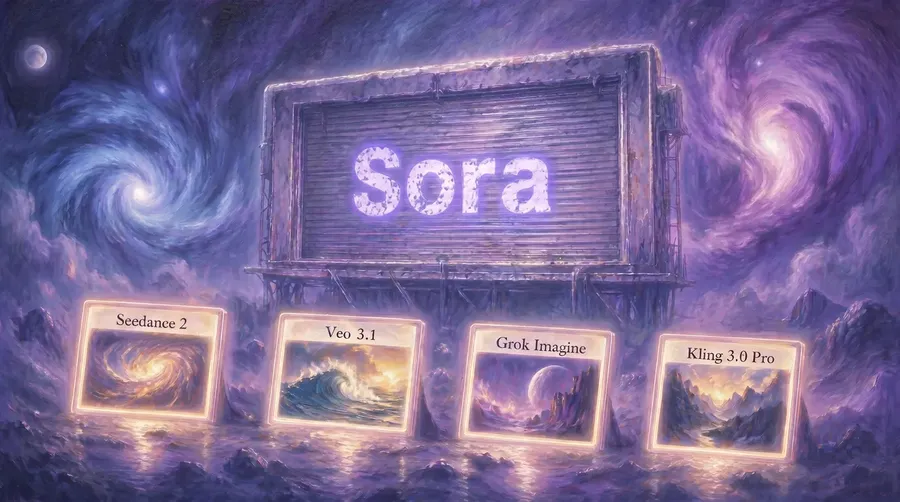
OpenAI’s Sora video generator has been discontinued. The standalone Sora app was shut down, and Sora 2, which was accessible through third-party platforms like getimg.ai, has now been retired as well, removed from getimg.ai and discontinued by OpenAI. If you’re looking for a reliable Sora alternative, several models now produce output that competes directly with Sora’s quality. The strongest options in 2026 are Seedance 2, Google Veo 3.1, Grok Imagine, and Kling 3.0 Pro / O3 — all available under one subscription on getimg.ai.
TL;DR Besta Sora Alternative (2026)
- Seedance 2 is the most versatile Sora alternative: 1080p output, native audio, clips up to 15 seconds, and the widest aspect ratio support of any model on this list.
- Google Veo 3.1 delivers the highest cinematic quality — accurate physics, native audio, and Google’s best video model to date.
- Kling 3.0 Pro / O3 leads for motion accuracy and character consistency across complex multi-subject scenes.
- All recommended models are available on getimg.ai’s video generator under one subscription — no separate accounts, no subscription juggling.
What Happened to Sora?
OpenAI launched Sora in early 2024 as a breakthrough text-to-video model — capable of generating high-definition, physically plausible video from natural language prompts. For many creators, it set the benchmark for what AI video generation could be.
OpenAI confirmed the full shutdown timeline: the Sora app closed on April 26, 2026, and the API — which powered third-party access including getimg.ai — stopped functioning on September 24, 2026. Sora 2 is now inaccessible everywhere, on getimg.ai and elsewhere.
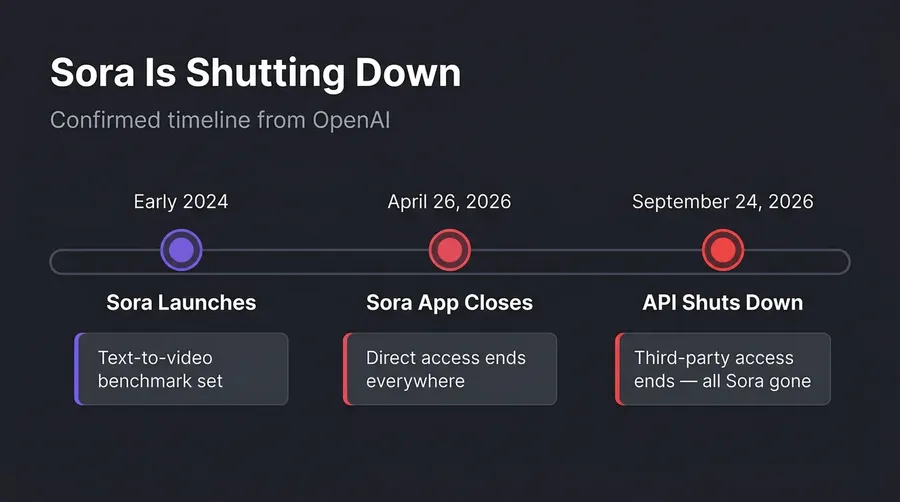
This isn't a collapse of AI video quality — it's the opposite. The models that have shipped since Sora's launch match or exceed it across most benchmarks. The AI video generation landscape in 2026 is more competitive than it's ever been, with serious alternatives from ByteDance, Google, xAI, Kuaishou, and Alibaba all generating production-quality output.
Moving to a Sora AI alternative — now that the API has gone dark — keeps your workflows running without skipping a beat.
The 5 Best Sora Alternatives in 2026
1. Seedance 2 — Best for Format Flexibility and Long-Form Clips
Developer: ByteDance
Why it ranks here: Widest format support of any model on this list, longest maximum clip duration, and 1080p output with native synchronized audio.
Seedance 2 is ByteDance’s unified multimodal audio-video generation model. It generates up to 15 seconds of audio-video output where both the visuals and the audio — background music, ambient sound effects, and character dialogue — are synthesized in a single generation pass rather than added separately. That joint architecture is what makes Seedance 2’s audio feel genuinely matched to what’s happening on screen.
Independent benchmarks back the quality claims: as of the April 16 Arena leaderboard, Seedance 2 ranks #1 for text-to-video (1,460 Elo) and #1 for image-to-video (1,454 Elo). On Artificial Analysis it holds #1 for image-to-video with audio (1,182 Elo) and #2 across other categories, behind HappyHorse — an as-yet-unreleased model from Alibaba.
Seedance 2.0 Video
Format support is the clearest Sora alternative advantage: Seedance 2 supports 1:1, 16:9, 9:16, 4:3, 3:4, and 21:9 aspect ratios — covering social video, broadcast, cinema, and vertical formats.
For marketing teams producing content across multiple platforms simultaneously — Instagram Reels (9:16), YouTube (16:9), LinkedIn (1:1), display ads (4:3) — that range means one model covers every format without switching tools. Clips run from 5 to 15 seconds, with first frame, last frame, and reference image controls for compositional consistency.
Seedance 2 Fast is a lower-cost, faster variant that generates at 720p rather than 1080p. If turnaround time or credit efficiency matters more than maximum resolution — rapid iteration, concept testing, high-volume campaigns — Seedance 2 Fast delivers the same motion quality and audio architecture at a lower cost per generation.
For more on how Seedance 2 compares to earlier ByteDance models, see the full Seedance 2.0 explainer.
2. Google Veo 3.1 — Best for Cinematic Quality
Developer: Google DeepMind
Why it ranks here: One of the most cinematic AI video models currently available, complete with realistic native audio.
Google Veo 3.1 is the current flagship from Google’s video research team, and it produces output that stands apart on visual realism, physical accuracy, and scene coherence. Where some models struggle with fluid dynamics, fast motion, or complex lighting, Veo 3.1 consistently handles them well.
Google Veo 3.1 Video
The model supports 16:9 and 9:16 aspect ratios with 8-second clip output, native audio, and reference controls including first frame, last frame, and reference image input. The 8-second cap is shorter than Seedance 2’s 15-second ceiling — but for most social and ad content, 8 seconds is workable, and the quality per frame is difficult to match.
Advertising agencies producing client campaign video, brand managers who need footage that passes as produced camera work, and architects or interior designers presenting spaces to clients before a build — these are the use cases where Veo 3.1’s quality ceiling matters most. Our full Google Veo 3.1 review covers the quality differences in detail.
3. Grok Imagine — Best for Photorealistic Video at a Lower Cost
Developer: xAI
Why it ranks here: Strong photorealism, flexible clip duration up to 12 seconds, native audio, and one of the most affordable models on this list per generation.
Grok Imagine is xAI’s video generation model, and it punches above what most people expected from xAI’s first serious video entry. The model produces photorealistic output across a range of prompt types — environments, products, characters, abstract motion — with native audio synchronized to the clip.
Grok Imagine Video
Clip duration is flexible from 4 to 12 seconds, giving more range than Veo 3.1’s fixed 8 seconds. Aspect ratios are 16:9 and 9:16. The model supports first-frame reference input for controlling how a clip opens — useful when you need a specific composition or character to persist into the video.
The cost advantage matters in practice. Social media managers and content marketing teams publishing regular video output — where per-clip cost compounds quickly across a month — get strong photorealistic quality without paying the premium of the top-tier models. It’s a practical choice for agencies and in-house teams with consistent volume but realistic credit budgets.
For Sora AI alternatives where the priority is realistic human and environment footage without a long production setup, Grok Imagine is a strong choice. Our Grok Imagine review breaks down where it performs best and how it fits alongside the other models.
4. Kling 3.0 Pro / O3 — Best for Motion Accuracy and Character Consistency
Developer: Kuaishou
Why it ranks here: Highly precise motion physics and strong character consistency — reliably handles complex multi-subject scenes where other models introduce artifacts.
Kling has been one of the most consistently high-quality video generation model families since its early releases, and the 3.0 Pro / O3 generation represents the most capable versions to date.
Kling 3.0 Pro Video
Kling 3.0 Pro generates clips from 4 to 15 seconds in 16:9 and 9:16, with native audio, and supports first-frame and last-frame control. It’s the highest-capability variant for one-off generation tasks where maximum quality is the goal.
Kling O3 delivers the same motion quality in clips up to 10 seconds, with the added flexibility of reference image, first-frame, and last-frame control alongside native audio. Both variants are available on getimg.ai.
Where Kling consistently stands out is in complex motion: two subjects interacting, hand and finger detail, motion that follows physical logic across a full 10–15 second clip. E-commerce brands shooting products in motion, ad agencies with character-driven creative, and social media teams where a person on screen needs to move naturally — these are Kling’s clearest professional use cases. For anything where subjects need to move convincingly, Kling 3.0 Pro / O3 holds up well under scrutiny.
How They Compare: Specs at a Glance
All of the above are available on getimg.ai under one subscription. No separate accounts. No per-model subscriptions. getimg.ai removed Sora 2 after OpenAI shut it down — and it keeps updating the model library as deprecations and new launches happen.
How to Choose the Right Sora Alternative
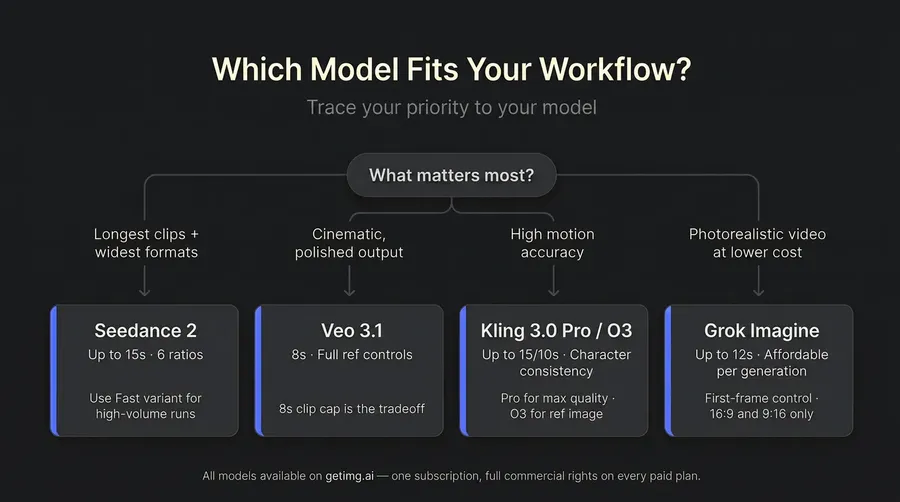
- If you need the longest clips and widest format support, Seedance 2 is the strongest all-round choice: 15-second clips, six aspect ratios, 1080p, and native audio from a single model. Use Seedance 2 Fast when you need to iterate fast or manage credit spend on high-volume runs.
- If cinematic realism is the priority, Google Veo 3.1 produces the most polished output — particularly for footage that needs to look like it was shot rather than generated. The 8-second clip cap is the tradeoff.
- If motion accuracy and character consistency matter, Kling 3.0 Pro / O3 handles complex multi-subject motion and natural human movement better than the alternatives — the right call for e-commerce product video, character-driven ad creative, and any content where people on screen need to move convincingly.
- If you need photorealistic video at a lower cost per generation, Grok Imagine is the strongest option — good photorealistic quality, native audio, and among the most affordable credit costs on the platform. Good fit for social media managers and content teams with consistent volume.
- If you’re building production workflows that will outlast any single model, use a platform that carries the full model library and updates as the landscape changes. That’s exactly what the text-to-video and image-to-video tools on getimg.ai are built for — access to all current models, auto-selected per task, under one subscription with full commercial rights.
The Practical Takeaway
Sora defined a generation of AI video expectations — and now the alternatives have caught up and, in several cases, moved ahead. Seedance 2’s benchmark performance, Veo 3.1’s cinematic quality, Kling’s motion accuracy, and Grok’s cost efficiency collectively represent a more competitive generation of tools than what existed when Sora launched.
The transition away from Sora 2 has already happened. The good news: the replacement options are strong, and they’re all accessible in one place.
getimg.ai carries all the models ranked in this article under one subscription with full commercial rights on every paid plan. Prompt enhancement and automatic model selection mean you can describe what you want to create without researching which model handles it best. The platform routes to the right model; you handle the creative direction.
Explore all video models on getimg.ai →
Frequently Asked Questions
Yes. OpenAI confirmed the full shutdown timeline: the Sora app closed on April 26, 2026, and the API — which powered third-party access to Sora 2 — stopped functioning on September 24, 2026. Sora 2 is now inaccessible everywhere, including on getimg.ai. Moving to an alternative avoids any workflow disruption.
For overall capability, Seedance 2 ranks highest among the current Sora alternatives: 1080p output, native synchronized audio, clips up to 15 seconds, and the widest format support of any leading model. For cinematic quality specifically, Google Veo 3.1 sets the current benchmark. Both are available on getimg.ai alongside three other strong alternatives — Grok Imagine and Kling 3.0 Pro / O3.
The leading alternatives to Sora’s app are platforms that give access to multiple video generation models — rather than single-model tools. getimg.ai provides access to Seedance 2, Google Veo 3.1, Grok Imagine, Kling 3.0 Pro, and Kling O3 under one subscription. That breadth lets you match the right model to each use case without managing separate accounts or subscriptions.
Both generate high-quality video from text prompts with native audio. Key differences: Seedance 2 supports significantly more aspect ratios (six vs. two for Sora 2), generates longer clips (up to 15 seconds vs. 12 seconds), and is fully supported today. Sora 2 produced strong results, particularly for scene composition, but OpenAI has discontinued it, so it is no longer available.
Sora 2 is no longer accessible. OpenAI closed the Sora API on September 24, 2026, so it is no longer available through getimg.ai or anywhere else. Seedance 2 and Google Veo 3.1 are the closest replacements — both produce output at or above Sora 2's quality level, and both are fully supported on getimg.ai.
By independent benchmark as: Seedance 2 ranks #1 on Arena for text-to-video (1,460 Elo) and image-to-video (1,454 Elo) as of April 16, and #1 on Artificial Analysis for image-to-video with audio (1,182 Elo). Google Veo 3.1 leads for cinematic realism and physical accuracy. Kling 3.0 Pro / O3 is a strong choice for motion quality and character consistency in complex multi-subject scenes. The best model depends on the specific output you need — which is why accessing all of them through a single platform gives a practical production advantage.
Kling O3 and 3.0. Pro both support API access through getimg.ai’s developer video generation API. The getimg.ai API is separate from the getimg.ai app subscription — it runs on top-up billing (pay-as-you-go), but doesn’t require a separate account for log in.
Related Articles