GPT Image 2: Official Release, Features & What's New (2026)
GPT Image 2 is officially here. After months of speculation (including the anonymous "tape model" tests on LM Arena covered in the article below) OpenAI announced ChatGPT Images 2.0, and it's now available on getimg.ai.
Ranked #1 for both text-to-image and image editing
As of this update, GPT Image 2 holds the top position on Arena.ai's leaderboard for both text-to-image generation and image editing. Arena.ai rankings are based on blind head-to-head comparisons where users pick the better output without knowing which model produced it — which makes the leaderboard a reliable proxy for real-world user preference rather than benchmark gaming.
Claiming number one across both categories at launch puts GPT Image 2 ahead of models like Nano Banana 2, which had been holding the text-to-image top spot.
What OpenAI Improved
OpenAI describes the release as "a step change in detailed instruction following, placing and relating objects accurately, and rendering dense text." The improvements break down across several areas worth understanding individually.
Instruction following and text rendering
The model is significantly better at executing complex prompts precisely — placing objects where specified, respecting spatial relationships, and handling the fine-grained elements that routinely caused problems in earlier versions: small text, UI labels, iconography, timestamps, and dense compositions.
If you've dealt with a model approximating what you asked for rather than executing it, this is the area where GPT Image 2 makes the most practical difference for production work.
Visual style and realism
Across a wide range of visual styles — photorealism, cinematic stills, manga, pixel art — the model shows noticeably stronger fidelity. It better captures the small imperfections that make realistic images feel authentic: grain, ambient light irregularities, natural framing, texture consistency.
OpenAI says the results "feel less AI-generated and more intentionally designed." For marketing creative, editorial work, or any context where generic-looking AI output is a liability, that's a meaningful shift.
Flexible aspect ratios at 2K resolution
The model generates at up to 2K resolution with a significantly expanded range of aspect ratios. On getimg.ai the 9 supported ratios cover the major output formats needed for content production — social, editorial, widescreen, portrait, and standard blog imagery — without the need to upscale or crop separately.
Multilingual text rendering
Inconsistent handling of non-Latin scripts has been a documented weakness across the GPT Image family. GPT Image 2 specifically improves rendering of Japanese, Korean, Chinese, Hindi, and Bengali — not just correct letterforms, but coherent visual layout when language is part of the design itself, from posters to infographics to editorial illustration.
World knowledge
With a knowledge cutoff of December 2025, the model draws on more current understanding of real-world contexts, environments, and visual references. OpenAI describes this as enabling smarter outputs "with less prompting" — the model fills in realistic contextual detail you'd otherwise have to specify explicitly.
How to try it
GPT Image 2 is available now on getimg.ai alongside multiple other leading image models. If you've been using GPT Image 1.5, the expanded aspect ratio support and the improvement in prompt precision are immediately noticeable.
For a hands-on comparison against other current models on the platform — including Nano Banana 2 and Seedream 5.0 Lite — it's worth running your existing prompts through GPT Image 2 to see where it pulls ahead. getimg.ai also gives you API access to GPT Image 2, so you can integrate it directly into your own tools and workflows.
The article below was originally published on April 8, 2026, before GPT Image 2 was announced. It covers the rumour cycle and leak evidence that preceded the official release:
There is no official GPT Image 2 yet. As of 8th of April 2026, OpenAI has not published a model page, API alias, blog post, or announcement for anything called gpt-image-2 or GPT Image 2. But the rumours are specific enough (and the evidence coherent enough) that it's worth laying out exactly what's confirmed, what's plausible, and what's still pure speculation. Here's everything we know about GPT-Image-2, the leaks driving the chatter, and a realistic read on when it might arrive.
TL;DR
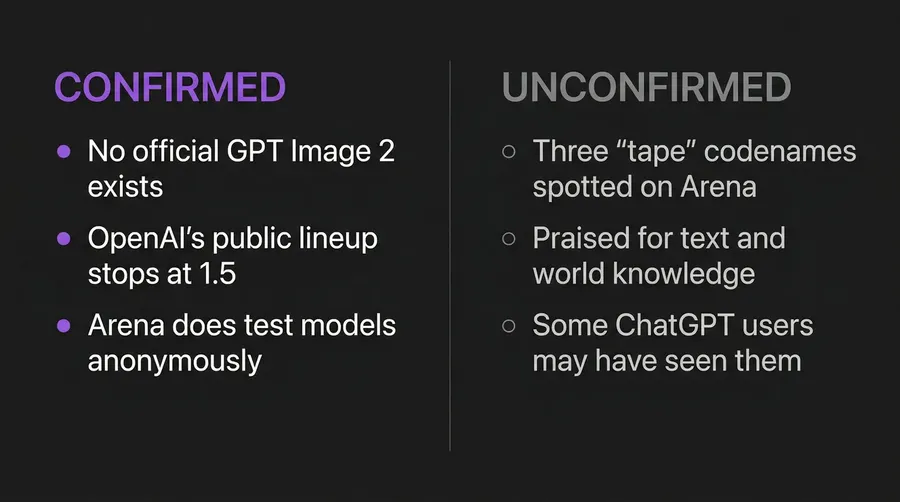
- OpenAI has not announced GPT Image 2 — the current public lineup stops at gpt-image-1.5 (released December 2025)
- Anonymous image models codenamed "packingtape," "maskingtape," and "gaffertape" reportedly appeared on LM Arena in early April 2026, with community testers praising their text rendering and world knowledge
- OpenAI has not confirmed the tape models are theirs, and the final public name may not be "GPT Image 2" at all
- No release date is confirmed; if Arena testing is underway, a launch within weeks or months is plausible — but that's inference, not a forecast.
What Is GPT Image 2?
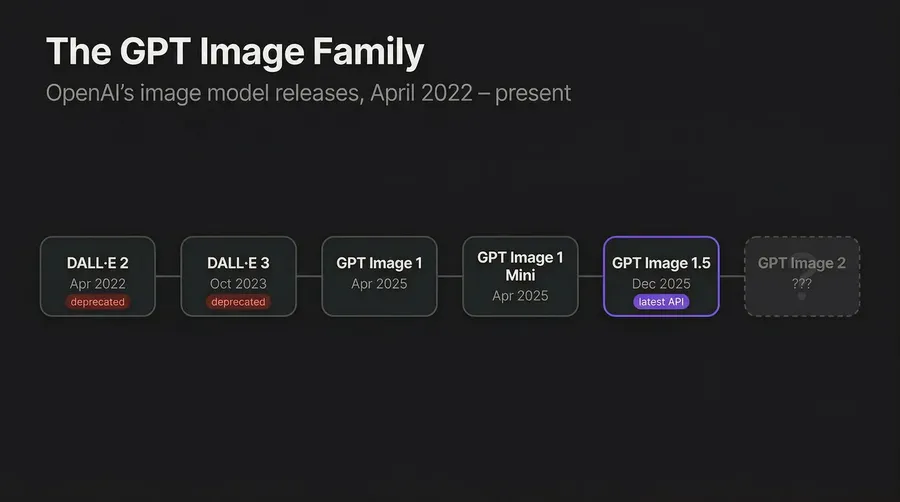
GPT Image 2 refers to the anticipated next major version of OpenAI's natively multimodal image generation model family. The current public lineup is gpt-image-1.5, chatgpt-image-latest, gpt-image-1, and gpt-image-1-mini, alongside the deprecated DALL·E 2 and 3. No model using the identifier gpt-image-2 currently exists in OpenAI's public model documentation, API, or "All models" page.
The GPT Image family (introduced with gpt-image-1) is designed to use broad world knowledge when generating images, not just the text in your prompt. That's a meaningful architectural distinction from earlier Text to Image models, and it's exactly where the rumoured improvements for a potential GPT Image 2 model are expected to show up.
GPT Image Version History
Understanding the cadence of OpenAI's image releases helps calibrate expectations for what comes next.
Version | Public Release | Key Characteristics |
DALL·E 2 | April 2022 | First major public OpenAI image model; now deprecated |
DALL·E 3 | October 2023 | Big prompt-following improvement; now deprecated |
GPT Image / | April 2025 | API release of OpenAI’s natively multimodal image model; strong prompt following, text rendering, and world knowledge |
| April 2025 | Smaller, cheaper/faster GPT Image variant |
| December 16, 2025 | Upgraded ChatGPT Images model; more precise edits, faster generation, better detail consistency |
| Ongoing | Alias for the image snapshot currently used in ChatGPT |
| Not released | No official OpenAI announcement as of April 9, 2026 |
One detail worth noting: `chatgpt-image-latest` is a separate API alias that points to "the image snapshot currently used in ChatGPT." A silent ChatGPT-side upgrade could happen behind that alias without OpenAI publicly naming the updated model.
On LM Arena's April 2026 single-image-edit leaderboard, `chatgpt-image-latest-high-fidelity` ranks first — above `gpt-image-1.5-high-fidelity` in fifth place. That gap is real. It doesn't prove a secret model exists, but it explains why people keep looking for one.
The Rumours: "Tape Models" on LM Arena
The strongest current rumour cluster centres on a set of anonymous image models that reportedly appeared on LM Arena in early April 2026.
What News Outlets Reported
On April 6, 2026, news outlets reported that OpenAI appears to be testing an "Image V2" model on LM Arena under three anonymous codenames: packingtape-alpha, maskingtape-alpha, and gaffertape-alpha.
The reports noted those models were later pulled from Arena. They also claimed some ChatGPT users were encountering outputs from these models, either through A/B testing or ongoing limited access. OpenAI has not confirmed any of this publicly.
What Community Testers Observed
Community posts corroborate that something unusual appeared in Arena around April 4, 2026. One user posted that a new OpenAI image model with "very strong world knowledge and text rendering" was appearing on Arena under the three tape codenames.
Another community member posted examples from the same models, praising their world knowledge and text rendering — with outputs involving an engineer's screen, a selfie with Sam Altman, a NeurIPS poster hall, Stanford campus, and a YouTube screenshot.
Other anecdotes describe one tape model allegedly rendering a watch time correctly and beating Nano Banana Pro on a Minecraft-Manhattan rendering task — while still failing a Rubik's cube reflection test.
These are community observations, not primary confirmation from OpenAI or Arena. They should be treated as directionally interesting, not conclusive.
Why the Rumour Is Plausible
Arena's own documentation confirms that image battle mode serves users two anonymous models, that Arena has helped test pre-release models, and that models tested anonymously can later be marked "preliminary" after a public release. A frontier lab quietly testing an unreleased model on Arena is not far-fetched. What isn't verified is which lab owns the tape models, or what the final public name would be.
The rumoured strengths also align with OpenAI's stated direction. OpenAI officially documents world knowledge and text rendering as GPT Image's core differentiators — and admits that current models still struggle with precise text placement, multilingual text, and some structured compositions.
The tape model examples focus on better UI mockups, more legible button text, accurate timestamps, and grounded real-world scenes. That's technically coherent with where OpenAI says they're still improving.
What Would GPT Image 2 Actually Improve?
As mentioned, based on OpenAI's own documented weaknesses in the current GPT Image family, the most likely areas of improvement for any GPT Image 2 model are:
- Text fidelity — more accurate rendering of spelled-out words, UI labels, timestamps, and multilingual strings
- UI and layout rendering — better handling of app screenshots, dashboards, and structured screen compositions
- Real-world scene grounding — more accurate depiction of real locations, events, and branded environments
- Character and face consistency — improved performance on multiple faces and repeated characters
- Complex structured prompts — better handling of prompts that specify precise spatial arrangements.
These aren't speculative wish-list items. They're areas OpenAI specifically lists as current model limitations, and they match exactly what rumour testers highlighted when evaluating the tape models.
GPT Image 2 Release Date: When to Expect It
There is no confirmed GPT Image 2 release date. OpenAI has not announced one. That said, the timeline from gpt-image-1 (April 2025) to gpt-image-1.5 (December 2025) was roughly eight months. If testing of something like the tape models is genuinely underway in April 2026, a release within the next few months would fit that cadence — but this is inference, not a forecast.
One useful calibration: in December 2025, TestingCatalog reported two codenamed models and speculated they would ship as Image-2 and Image-2-mini. The public release that followed six days later was GPT Image 1.5, not a model called Image-2. Outside observers can be directionally right about "something new is being tested" while still getting the public name and packaging wrong. The same applies now.
The honest summary: if the tape models are real OpenAI models currently in Arena testing, release could come anywhere from weeks to months out. If they're something else, or misidentified, the timeline is unknown. Nothing in any official OpenAI source currently points to an imminent gpt-image-2 launch.
Competitive Context: Where OpenAI Stands Right Now
One reason people expect another OpenAI image push: the competitive pressure is visible in public benchmarks.
On the April 9, 2026 LM Arena text-to-image leaderboard, Google's gemini-3.1-flash-image-preview (Nano Banana 2) holds first place. OpenAI's gpt-image-1.5-high-fidelity sits second.
On the single-image-edit leaderboard, OpenAI's chatgpt-image-latest-high-fidelity leads first place, with gpt-image-1.5-high-fidelity fifth.
OpenAI is competitive, especially in AI image editing, but not dominant across the board. Google's Nano Banana 2 leading text-to-image is a meaningful signal. It's exactly the kind of gap that historically precedes a major release.
What to Believe and What to Ignore
The tape models are the strongest signal here — not because they're confirmed, but because the reports are specific, named, and technically coherent with OpenAI's known roadmap. Something unusual appeared in Arena. Multiple independent sources noted the same standout qualities. That's meaningful. What it doesn't tell you is who built those models, what they'll be called publicly, or when they'll ship.
The parts of the story worth ignoring: claims that GPT Image 2 is "imminent," that a mini variant is confirmed, or that release timing is known. None of that appears in any official OpenAI source. The December 2025 cycle — where leaks pointed to "Image-2 and Image-2-mini" and the actual release was GPT Image 1.5 — is a useful reminder that directional accuracy and naming accuracy are different things.
OpenAI is clearly developing a next image model. Whether it ships as GPT Image 2, GPT Image 1.6, or something else entirely, no one outside OpenAI knows yet.
How to Use GPT Image Models Today
While gpt-image-2 is still unconfirmed, the current GPT Image models are available right now — and they're worth trying.
On getimg.ai, you can access both GPT Image 1 and GPT Image 1.5 directly alongside many other leading image models — including Nano Banana 2, FLUX.2, Seedream 5.0 Lite, and Grok Imagine — under one subscription. The platform's auto-selection handles model routing, so you can focus on output quality rather than model research.
When GPT Image 2 releases, it will be added to the platform. Until then, GPT Image 1.5 remains the best publicly available version of OpenAI's image generation technology, and it's available for generation and editing workflows right now.
Frequently Asked Questions
No. As of April 9, 2026, there is no official OpenAI announcement, model page, API alias, or documentation entry for GPT Image 2. The public image lineup stops at gpt-image-1.5.
There is no confirmed release date. OpenAI has not announced one. Community reports suggest testing may be underway, but no launch timeline is verified.
In early April 2026, news outlets reported that three anonymous image models — named packingtape-alpha, maskingtape-alpha, and gaffertape-alpha — appeared briefly on LM Arena. Community testers praised their text rendering and world knowledge. OpenAI has not confirmed whether these models belong to them or what they represent.
No official comparison exists because GPT Image 2 hasn't been released. Rumoured improvements focus on text fidelity, UI rendering, real-world scene accuracy, and face consistency — areas where gpt-image-1.5 still has documented weaknesses.
GPT Image 1 and 1.5 are available on getimg.ai alongside 27+ other leading AI models. All paid plans start at $8/month and include commercial rights.
Unknown. In December 2025, leaks speculated about Image-2 and Image-2-mini, and the actual release was GPT Image 1.5 without a separately named mini. Whether a gpt-image-2 model includes a mini variant depends entirely on what OpenAI decides to announce.
Related Articles